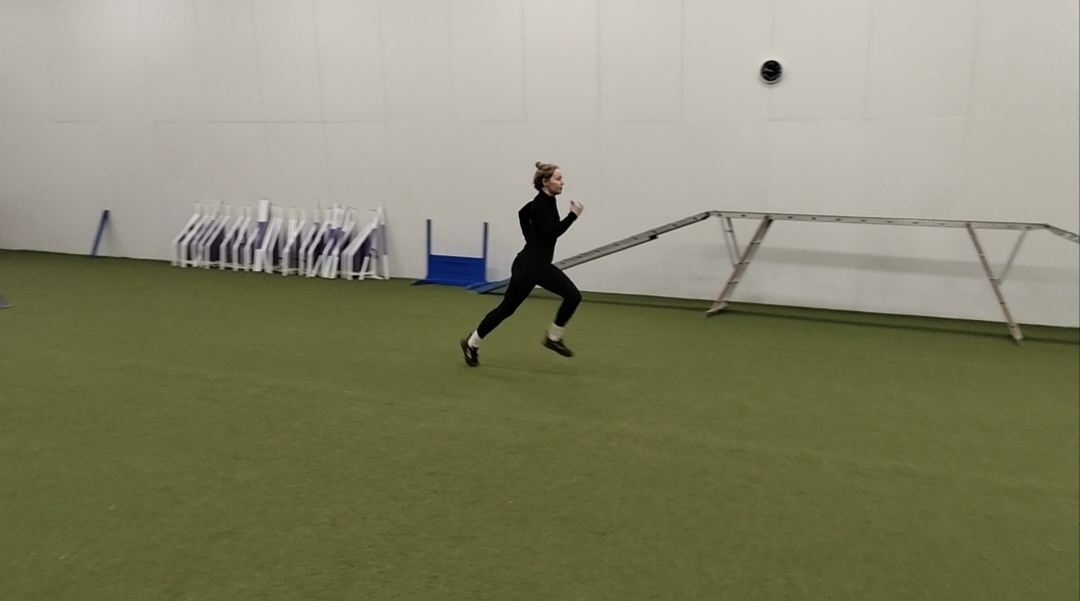
Running fast is only one piece of the puzzle.
Great agility handlers don’t simply sprint from obstacle to obstacle – they accelerate, decelerate, change direction, rotate, balance, and react continuously throughout every course.
These movement skills can all be trained.
Acceleration
The first few steps after a stop or change of direction often have the biggest impact on your handling.
Improving acceleration allows you to create distance more quickly, support your dog’s lines, and arrive where you need to be sooner.
Deceleration
Being able to slow down efficiently is just as important as being able to speed up.
Good deceleration helps you stay balanced before turns, avoid over-running handling positions, and prepare for the next movement without losing control.
Change of direction
Agility courses demand constant movement in every direction.
Training lateral movement, cutting mechanics, and body control helps you move more smoothly through crosses and tight turns while reducing unnecessary energy loss.
Balance and stability
Strong balance allows you to stay in control, even when you’re moving at speed or changing direction unexpectedly.
Single-leg stability and core control improve your ability to handle confidently without feeling unstable or rushed.
Coordination and reaction
Handling requires quick decisions and precise movement.
Practising coordination, rhythm, and reactive drills helps your body respond faster while making movement feel more automatic.
Train movement, not just fitness
General fitness is valuable, but agility handlers benefit most from exercises that reflect the demands of the sport.
By improving the movement skills you actually use on course, you’ll become more efficient, more consistent, and more confident every time you run.
Small improvements in movement quality often lead to surprisingly big improvements in performance.
No responses yet